
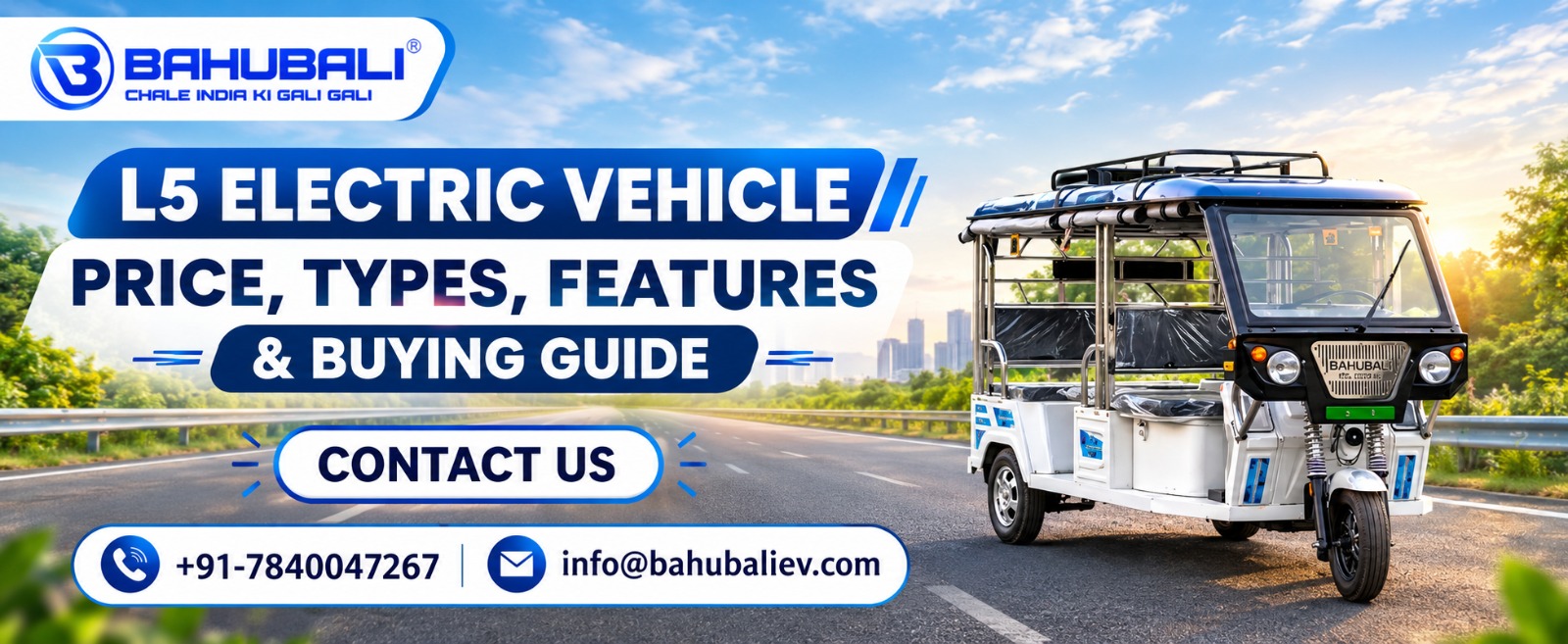
L5 Electric Vehicle: Price, Types, Features & Buying Guide
Introduction
Electric rickshaws are widely used for passenger and cargo transport and an L5 Electric Vehicle is a special category with a speed more than 25 km/h according to the Indian vehicle category. It can include passenger and cargo models with different seating, payload, battery, motor capacity and design qualities. Understanding the L5 type before purchasing is important because of its specifications, registration process and pricing.
This guide explains what L5 means, how L3 differs from L5 and which manufacturers offer the best L5 models in India. It also covers average L5 pricing, factors that change the final cost and key features buyers should compare. The guide further explains what to consider when comparing Bahubali EV with other L5 options.
What is L5 in EV?
An L5 Electric Vehicle is a three wheeled motor vehicle classified for carrying passengers or goods with maximum speed above 25 km/h under AIS 053. The category includes passenger carriers and goods vehicles so buyers can find different body designs, payload ratings, battery options and commercial uses. For passenger transport the sub category is L5M while L5N refers to goods transportation vehicles.
What does L5 mean for buyers?
L5 Electric Vehicle classification tells buyers that the vehicle belongs to a defined three wheeler category more than simply being a low speed E rickshaw.
-
Vehicle type: Three wheeled motor vehicle.
-
Main use: Passenger or goods transport.
-
Speed rule: Above 25 km/h under AIS 053.
-
Passenger form: L5M autorickshaw.
-
Goods form: L5N vehicle.
-
Specifications: Depend on approved model.
-
Documents: Check type approval and registration details.
A buyer should verify the exact model documents, battery details, warranty, service support and approved specifications before making payment.
What is the difference between L3 and L5 Electric Vehicles?
L3 and L5 Electric Vehicles are different vehicle categories, not simply two versions separated by speed or battery capacity. Under the relevant classification, L3 refers to a two wheeled motor vehicle, whereas L5 refers to a three wheeled motor vehicle.
L3 vs L5 at a glance
-
L3 category: Two wheeled motor vehicle.
-
L5 category: Three wheeled motor vehicle.
-
L5 passenger version: L5M.
-
L5 goods version: L5N.
-
L5 speed threshold: Above 25 km/h.
-
Main purpose: Passenger or goods transport.
-
Buyer check: Verify the registered category.
Who are the leading L5 Electric Vehicle manufacturers in India?
The Indian L5 market includes established companies and newer manufacturers offering passenger and cargo three wheelers for commercial transport.
Leading L5 Electric Vehicle manufacturers:
-
Mahindra
-
Piaggio
-
Altigreen
-
Euler Motors
-
Atul Auto
-
Omega Seiki
-
Bahubali EV
Mahindra has a strong L5 presence and its FY25 report stated a 37.3% market share in the L5 category.
Bahubali EV also offers their best L5 E rickshaw & auto rickshaw such as the Bahubali XXL9 Prime and BAHUBALI XXL9 ULTRA AUTO showing how its L5 vehicles are used in passenger transport needs.
What should buyers compare:
-
Battery: Type, capacity, warranty and replacement terms.
-
Range: Certified figure versus expected working distance.
-
Payload: Approved load capacity for the chosen model.
-
Charging: Charging method and available charging time.
-
Service: Dealer, workshop and spare part support.
-
Finance: Down payment, interest, EMI and total repayment.
-
Approval: Registration and category documents.
No manufacturer is automatically best for every buyer, because daily distance, load, charging access, budget and service location can change the suitable choice.
What is the average price of an L5 Electric vehicle in India?
An L5 Electric can cost differently depending on its battery, body design, payload, motor, manufacturer and state.
For example, current listings show Mahindra Treo and Treo Plus around ₹2.9 lakh to ₹3.7 lakh, depending on model and market. Bahubali EV L5 models can cost around ₹2.5 lakh or more so buyers should check these figures as indicative more than fixed prices.
What changes the final price:
-
Battery capacity and type.
-
Passenger or cargo body design.
-
Motor power and approved specification.
-
Payload rating and capacity.
-
State level EV benefits or charges.
-
Dealer offers and finance terms.
-
Insurance and registration expenses.
-
Included equipment and warranty.
Always request a written on road quotation because an advertised showroom figure does not show the complete purchase amount.
Why choose Bahubali EV for L5 Electric vehicles?
Bahubali EV offers electric three wheelers for passenger and commercial transport, including models such as Bahubali XXL9 ULTRA AUTO. Its L5 Electric Vehicle range is decided by the exact model specifications, approved category, battery option, seating, range, warranty and support available.
Bahubali EV is considered when its vehicle specifications match the buyer’s daily route, work type, budget and charging arrangement.
Buyers should check before choosing Bahubali EV:
-
Exact model: Confirm the required L5 model.
-
Capacity: Check passenger seating or cargo payload.
-
Battery: Confirm type and available capacity.
-
Range: Compare claimed range with daily requirements.
-
Service: Ask about authorised support near your location.
-
Warranty: Read battery and vehicle coverage carefully.
-
Finance: Confirm down payment, EMI and repayment.
-
Documents: Verify registration and approval details.
A test drive can also help buyers to decide seating, steering, braking, comfort and general vehicle feel before making a booking.
L5 Electric Vehicle buying checklist for first time buyers
Before booking an L5 Vehicle focus on details that affect daily work during regular daily operations instead of choosing only from advertisements.
-
Confirm the exact L5 category.
-
Check battery warranty and replacement terms.
-
Compare certified and claimed ranges.
-
Ask about charging time.
-
Verify payload or passenger capacity.
-
Check nearby service support.
-
Get the complete on road price.
-
Read finance terms carefully.
-
Confirm registration requirements.
-
Take a test drive.
For many buyers an L5 Vehicle is mainly a work vehicle so useful comparison starts with daily distance, passenger count or load, charging access, battery warranty, service location and total monthly payment rather than appearance or promotional claims for your business.
Conclusion
When selecting an L5 Electric Vehicle look at the category, approved speed, vehicle function, pricing, battery, warranty and after sales service. L5 models are three wheeled vehicles which are designed for passenger or cargo transport with manufacturers offering a range of batteries, payloads, body designs and features. The best choice for customers is not usually the most affordable option because regular work needs should lead to the final model selection.
Bahubali EV can be compared to other manufacturers when the exact model fits the buyer's route, price, charging availability and support needs. To avoid problems after delivery, double check papers, specifications, warranty, financing terms and the total on road pricing before making a payment. A practical comparison based on verified details helps buyers choose an L5 three wheeler for real work instead of depending only on marketing claims.

